USDC
| Market | Risk | Net APY | Change | TVL |
|---|
| B | 5.10% | -0.19% | $174M | |
| B | 4.74% | +0.49% | $139M | |
| B | 4.52% | +0.61% | $309M | |
| A | 3.99% | +0.69% | $50M | |
| A | 3.65% | +0.20% | $4197M | |
| A | 3.47% | -0.01% | $341M | |
| A | 3.45% | -0.04% | $125M | |
| B | 3.44% | -0.01% | $368M | |
| B | 3.43% | -0.02% | $136M | |
| A | 3.43% | -0.02% | $422M | |
| A | 2.70% | -0.90% | $397M |
USDT
| Market | Risk | Net APY | Change | TVL |
|---|
| A | 2.96% | -0.48% | $242M | |
| A | 2.66% | +0.05% | $178M | |
| B | 2.61% | +0.02% | $110M | |
| B | 2.47% | -0.57% | $170M | |
| A | 2.41% | -0.37% | $6509M | |
| A | 2.37% | -0.26% | $209M |
WETH
| Market | Risk | Net APY | Change | TVL |
|---|
| A | 3.32% | +1.14% | $350M | |
| A | 1.53% | -0.11% | $669M | |
| A | 1.36% | +0.10% | $7734M | |
| A | 1.32% | -0.02% | $153M |
wstETH
| Market | Risk | Net APY | Change | TVL |
|---|
| A | 0.02% | +0.02% | $10M | |
| A | < 0.01% | 0.00% | $4222M | |
| A | < 0.01% | 0.00% | $1480M |
WBTC
| Market | Risk | Net APY | Change | TVL |
|---|
| A | < 0.01% | 0.00% | $3207M |
PYUSD
| Market | Risk | Net APY | Change | TVL |
|---|
| B | 3.10% | +0.13% | $132M | |
| B | 1.79% | +0.26% | $249M | |
| A | 1.73% | +0.01% | $387M | |
| A | 1.17% | -0.64% | $100M |
USDS
| Market | Risk | Net APY | Change | TVL |
|---|
| A | 3.16% | +2.36% | $6.0M | |
| A | 2.75% | +0.07% | $480M | |
| A | 0.41% | -0.11% | $39M |
USDtb
| Market | Risk | Net APY | Change | TVL |
|---|
| A | 0.50% | +0.05% | $196M |
EURC
| Market | Risk | Net APY | Change | TVL |
|---|
| A | 3.09% | +0.19% | $81M |
Help us make DeFi transparent
Share onFAQ
Tezoro covers 2,000 markets across the largest TVL protocols on Ethereum, including Aave V3, Spark, Compound V3, Euler V2, Morpho Blue, Morpho Vaults, and Fluid.
To maintain a consistent risk baseline, Tezoro applies conservative internal risk screens and only surfaces markets that meet our minimum rating — markets rated A–C are shown in the interface; markets rated D and below are excluded.
More protocols and markets will be added soon.
Net APY is the annualized return paid in the supply token, after excluding protocol incentives and reward tokens — in other words, the real yield you can expect without marketing or extra rewards.
Example: if you supply 100 USDC and the Net APY is 5%, you would earn 5 USDC over one year.
Tezoro has developed a proprietary AI-driven risk engine that combines large language models (LLMs) with a Retrieval-Augmented Generation (RAG) workflow to evaluate protocol and market risk at scale.
Assessment framework (weighted criteria)
Each market is scored across multiple criteria (each criterion carries a configurable weight):
- Technical risk: smart-contract code quality and security audits, oracle and infrastructure robustness, and dependency/stack risk.
- Economic risk: strategy design (looping, leverage, liquidation mechanics), collateral quality & liquidity, TVL level and dynamics, and yield volatility.
- Governance risk: governance architecture (DAO / multisig / EOA), admin keys & upgradability (timelocks, access controls), and existence of risk-management processes, insurance or reserves.
- Monitoring & operational signals: withdrawal/UX incidents, on-chain flows (TVL outflows, large/whale movements), and sentiment & news signals.
Scoring & tiering
We aggregate the weighted scores into a single security score for each market. That score maps to a risk tier:
- A: Low risk. Typical examples: core lending and staking markets (Aave, Spark, Compound, Morpho Blue) with TVL > $100M.
- B: Moderate risk. Markets with reputable maintainers, significant TVL and time on market — commonly found on protocols such as Morpho, Euler, and Fluid.
- C: Elevated risk. Other markets that have reached at least 50% of the maximum security score and have TVL > $1M.
This framework is continuously calibrated: criterion weights, signal sources, and thresholds are reviewed by our risk team to reflect evolving on-chain behaviour and new threats.
Tezoro runs its own blockchain indexer that reads smart contract state directly from Ethereum archive nodes. The indexer takes hourly snapshots of every tracked vault and lending market — recording share prices, total assets, total supply, utilization, and accrued revenue. Asset prices come from Chainlink on-chain oracles. All data flows through our proprietary aggregator that computes yield metrics from these raw snapshots — no third-party APIs, no off-chain data feeds.
Tezoro is a completely independent data source and provides honest and transparent information:
- No one ever pays for listings — all data is taken directly from the blockchain.
- Tezoro software is completely proprietary — we don't use any third-party data providers, so data manipulation is impossible.
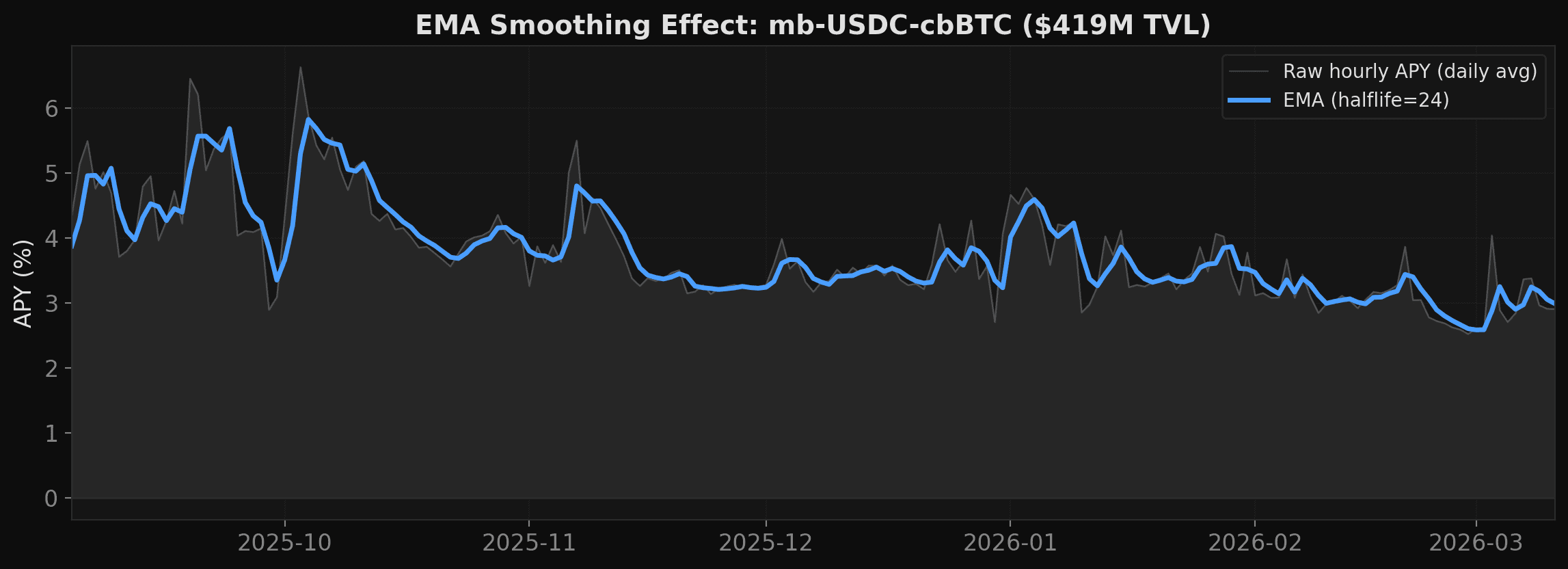
Net APY reflects the actual yield that depositors earned over a chosen period (Day, Week, or Month), annualized. Unlike most aggregators that display protocol-advertised rates (projections of what you might earn if conditions stay the same), Tezoro measures what already happened on-chain. Longer windows give a smoother picture; shorter windows react faster to changes.
The calculation works differently depending on the protocol type, but in both cases the source data is read directly from smart contracts:
- Vault-based protocols (Euler, Fluid, Morpho Vaults) — we track the share price of the vault . Share price grows as the vault earns yield and already has protocol fees deducted at the contract level:where is the on-chain share price and is the measurement period.
- Lending protocols (Aave, Compound, Spark) — we track accrued revenue relative to TVL:where is cumulative protocol revenue and is the average total value locked across hourly snapshots.
Our indexer reads on-chain state approximately every hour, building a continuous history of share prices, TVL, and revenue. No off-chain estimates, no manual inputs — only verifiable blockchain data.
The Change column shows how APY shifted compared to the previous period. It compares two consecutive windows of the same length:
A positive value means the yield is trending up; a negative value means it is trending down. Because both windows have the same duration, the comparison is balanced and captures real momentum rather than short-term noise.
All data is read directly from smart contracts via Ethereum archive nodes at approximately 1-hour intervals. The indexer captures share prices, TVL, utilization, and revenue from every tracked vault and lending market. Asset prices come from Chainlink on-chain oracles. There are no third-party data providers in the pipeline — every number traces back to verifiable on-chain state.
All APY and Change values are displayed with exactly 2 decimal places (e.g., 3.14%, +0.45%). The Change value is rounded at calculation time using banker-safe rounding:
This means what you see is the precise rounded result, not a display-layer approximation.